
Checking Criminal History in Clinton County
Start with the Clinton County event or status that needs proof. Iowa Courts Online Search is the first stop for a Clinton public docket, filed charge, or disposition. The Clinton County jail roster answers a present-custody question. Clinton County Sheriff Records or the police agency that handled the event holds the incident narrative. DCI supplies the separate statewide Iowa repository check. A careful Clinton search keeps those products apart because a booking, charge, and conviction are different facts.
Have the full name, exact date of birth, prior names, and a Clinton case or incident number when available. Common names require extra care. Clinton court results should be matched by case type and county, while DCI says only fingerprints can establish a positive identity.
- Search Iowa Courts Online and select Clinton as the county.
- Open the blue Case ID and review charges, filings, and each disposition.
- Check current custody through the county inmate portal when the event is recent.
- Ask the arresting agency for its report if the officer narrative is needed.
- Order a DCI check or certified court copy when an official product is required.
The official Clinton County gateway shows where county services begin.

Its department links lead to the sheriff, courts, and other record custodians without relying on a commercial people-search site.
Clinton County Record Offices
Two Clinton buildings divide much of the Clinton County work. The Clinton County Courthouse at 612 North Second Street houses the Clinton Clerk of Court and County Attorney. The Clinton Law Center at 241 Seventh Avenue North houses the sheriff, jail, report counter, fingerprint service, and local sex-offender registration work. The Clinton courthouse is open weekdays from 8:00 a.m. to 4:30 p.m.; Law Center public hours are weekdays from 8:00 a.m. to 4:00 p.m.
The Clinton Law Center bars electronic or digital communications devices. Leave phones and similar devices in a vehicle or another nonpublic place before entering. Clinton courthouse visitors pass through a metal detector and x-ray screening. These Clinton County rules matter when a reader plans to use the public court terminal, collect a report, or attend a fingerprint appointment.
Clinton County Clerk
612 N. Second St., Clinton, IA 52732
563-243-6213
Case files and court terminal
Sheriff Records
241 Seventh Ave. N., Clinton, IA 52732
563-242-9211
Reports, jail, prints, registry
County Attorney
612 N. Second St., Clinton, IA 52733
563-243-6218
Filed prosecutions and victim support
The county court route identifies the courthouse connection to Iowa’s Judicial Branch.
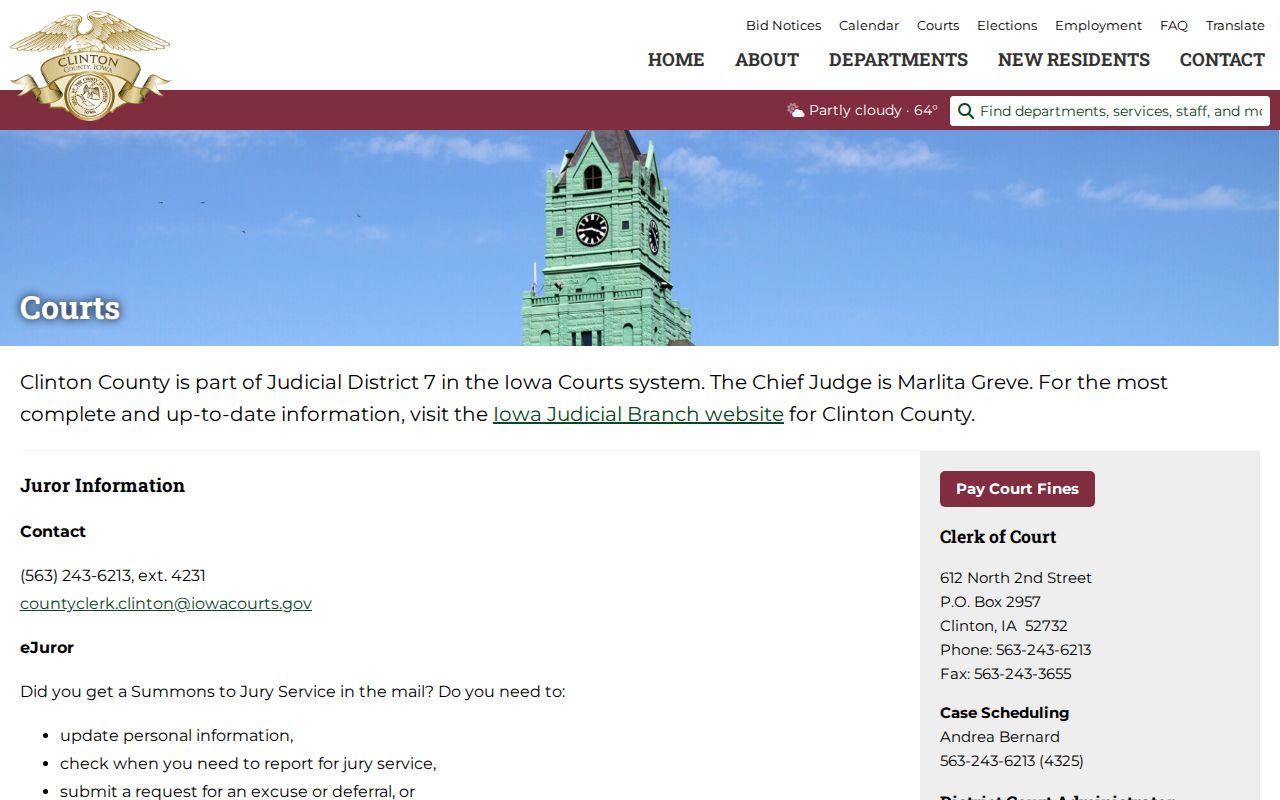
This source helps separate clerk-held court records from sheriff-held police and custody records.
Iowa Official Background Checks
The Iowa Department of Public Safety, Division of Criminal Investigation is the central repository for fingerprint-backed Iowa criminal-history information, including reported Clinton events. A Clinton County reader may request a name-based check with a first name, last name, and exact date of birth. Each last name searched costs $15. Middle name, gender, and Social Security number can help DCI distinguish people with similar Clinton County names.
DCI accepts Clinton County requests online, by mail, fax, email, and in person, but not by phone. Online requests need both request and billing information. Without the subject’s signed DCI-77 authorization, DCI withholds completed deferred judgments and Clinton arrests more than 18 months old with no final disposition from a non-law-enforcement requester. Juvenile records remain confidential. The product covers Iowa repository data, not other states, federal convictions, or all FBI records.
The DCI instructions explain the product and its limits.
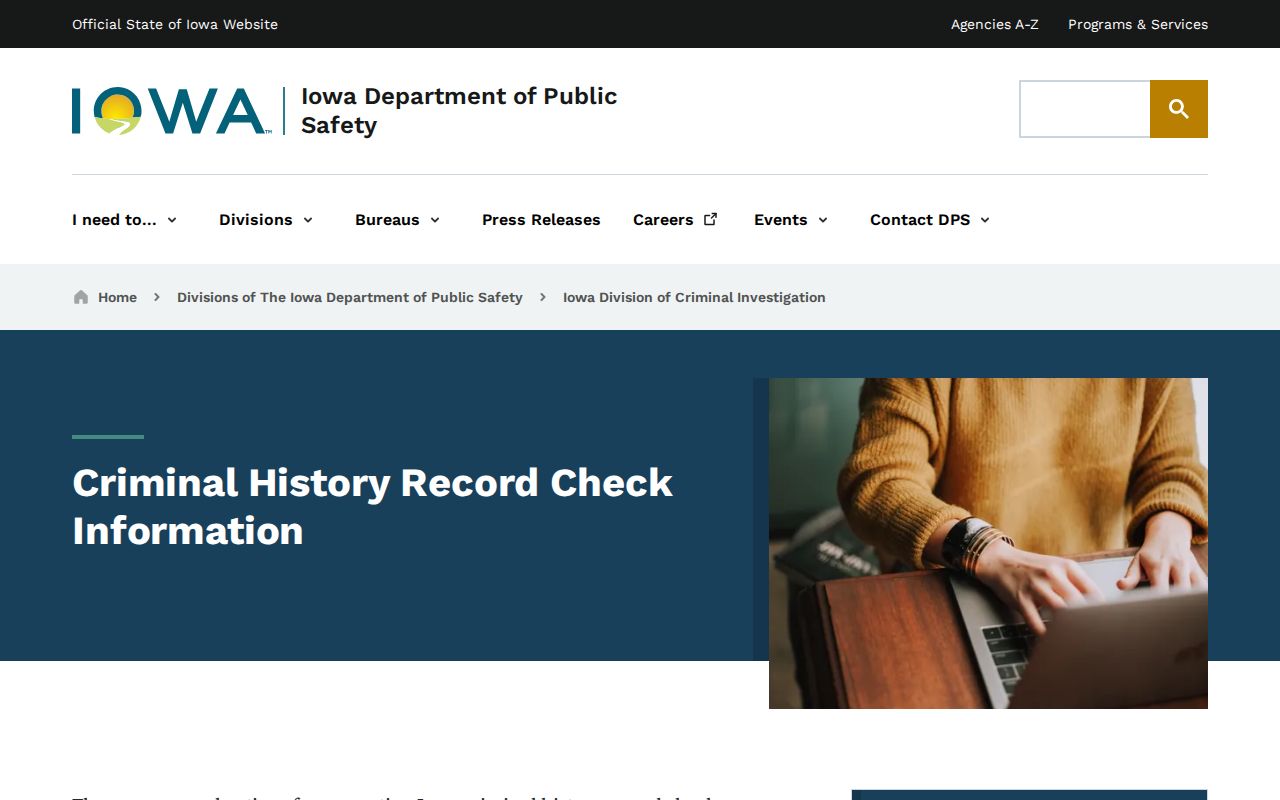
The official directions also describe correction requests when a reader believes an Iowa record is wrong.
Clinton County DCI Request Details
The Iowa Record Check Online form collects Clinton requester and subject details in one state workflow. DCI publishes a usual Clinton County electronic response range of one to three days depending on volume, while its FAQ gives a broader two-to-five-business-day range. The Des Moines counter can provide an immediate Clinton result only to the record subject who presents government photo identification.
| Field group | What DCI requests |
|---|---|
| Requester | Name, mailing address, phone, fax, email, and delivery choice |
| Subject | Last, first, middle name, exact birth date, gender, and optional SSN |
| Payment | Number of last-name searches, $15 each, and payment details |
| Authorization | Optional subject signature that changes disclosure of restricted nonconviction data |
The official DCI billing and request form sends a Clinton County request; it is not a public Clinton browse tool.
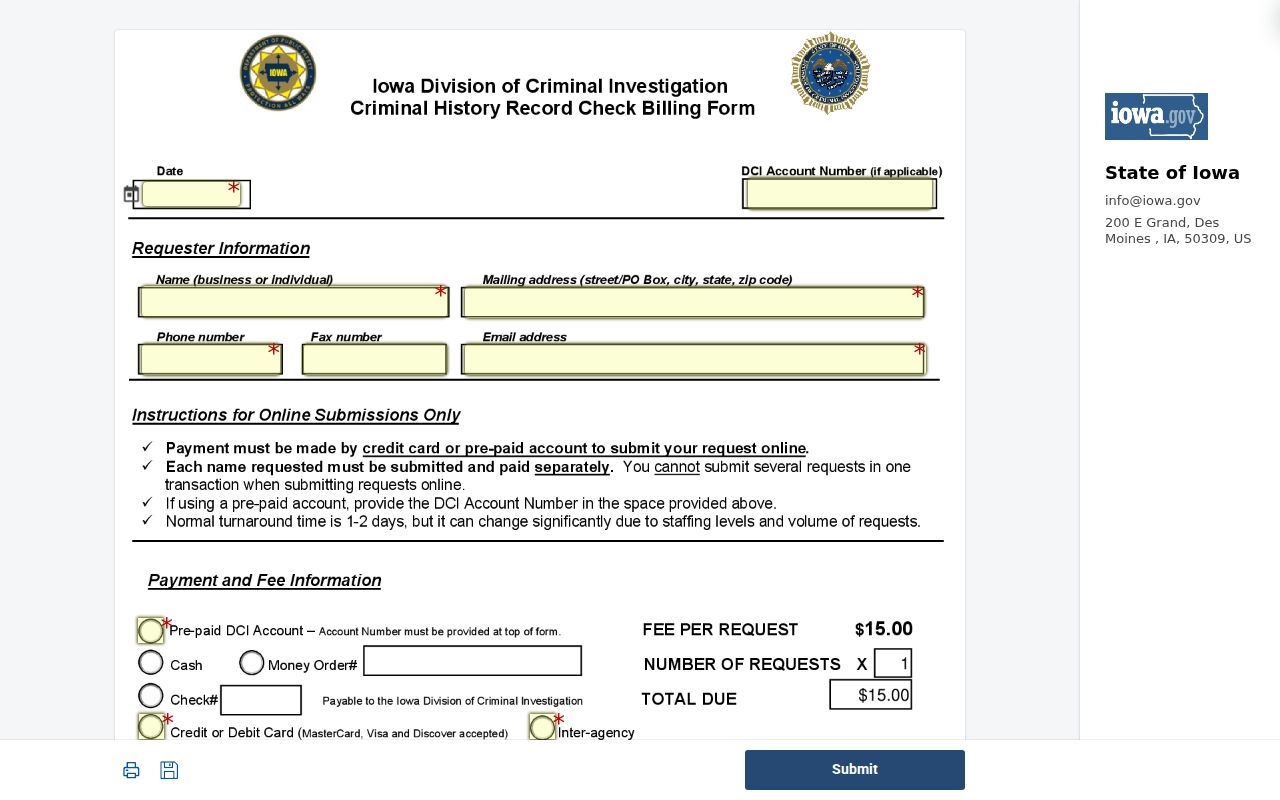
Its fields show why exact birth data and the authorization choice can change how a result should be read.
Criminal Record Types
Clinton County criminal records form a chain rather than one master file. Clinton police or a county deputy creates an incident or arrest report. Clinton jail staff create a booking entry if the person enters custody. The Clinton County Attorney may file a complaint or trial information, and the Clinton clerk opens the court case. Fingerprints and later Clinton outcomes can flow to DCI. State custody and supervision appear through Iowa corrections channels.
- Incident report: the arresting agency’s narrative, subject to lawful redaction.
- Booking record: a current county custody entry, not proof of guilt.
- Court file: charges, events, rulings, financial entries, and outcome.
- DCI history: fingerprint-backed Iowa cycles and reported dispositions.
- Registry or supervision record: a specialized public record with its own limits.
For a deeper account of the transition from custody to filed charges, use the county arrest lookup. No complete official county warrant portal was found. A person addressing a possible warrant should confirm procedure with counsel, the clerk, County Attorney, or sheriff instead of treating a docket event as real-time warrant proof.
Clinton County Sheriff Records
Clinton County Sheriff Records is the practical fallback for incidents within sheriff jurisdiction. It has no public Clinton incident-report request form. Readers can use the Clinton Law Center counter, call 563-242-9211, email ccso@gapa911.us, fax 563-243-7993, or send a focused Iowa chapter 22 request. A good Clinton request names the record type, approximate date, event or case number when known, and the desired delivery method.
Clinton County publishes exact prices for several services. It does not publish a broad Clinton search fee, special form, or firm turnaround for sheriff reports. Iowa Code section 22.3 permits reasonable actual costs, so any other Clinton charge should be confirmed before ordering.
| Service | Fee | Key requirement |
|---|---|---|
| Incident report | $2 | Sheriff-jurisdiction event |
| Accident report | $4 | Contact Sheriff Records |
| Driving record | $8.50 | Application and driver license |
| Resident fingerprinting | Free | Appointment and current-address ID |
| Nonresident fingerprinting | $10 | Appointment and blank card |
The official Sheriff Records page is the source for these local services.
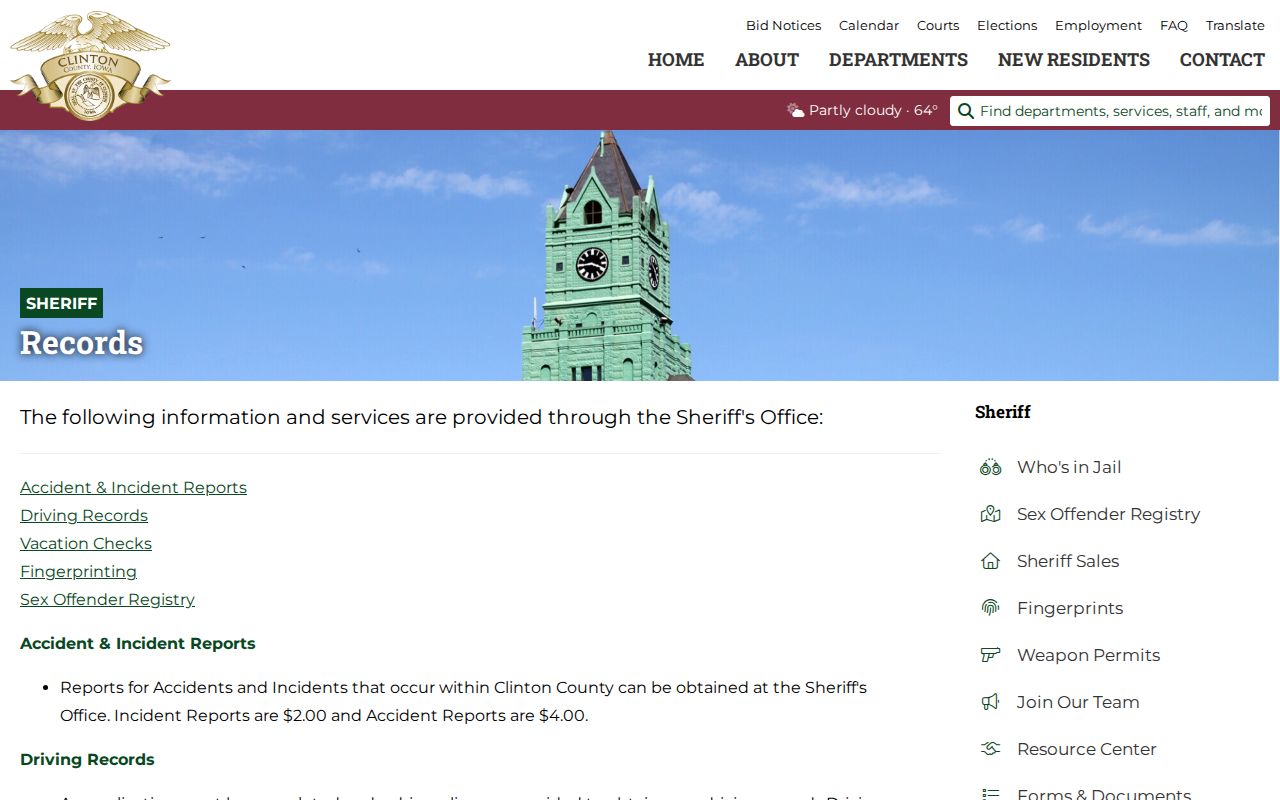
Its product list also makes clear that a local incident report is not a statewide DCI history.
Inside a Clinton County Criminal Record
Clinton content depends on which record is open. A DCI history centers on identity and fingerprint-supported Clinton arrest cycles. Iowa Courts Online organizes Clinton information by case, party, charge, filing, bond, and financial obligation. The Clinton County roster is limited to current custody, while a Clinton agency report may contain an event narrative and evidence references that do not belong in the public court index.
| Name and identifiers | Names, aliases, birth data, and other matching details allowed for that record. |
|---|---|
| Arrest or booking | Agency, date, intake status, and initial allegations when reported. |
| Charges | Count, Iowa or city code, description, and later amendments. |
| Disposition | Dismissal, acquittal, guilty result, or another recorded outcome. |
| Sentence | Custody, probation, fines, restitution, surcharges, and related orders. |
| Current status | Custody or supervision data only when the source lawfully displays it. |
“No Iowa Criminal History Found” is not always the same as no event ever occurred. DCI may have no fingerprint-supported entry, or the available data may be confidential or restricted without authorization. Match any DCI response against the public court outcome and contact DCI about an accuracy dispute.
Clinton County Jail Records
The Clinton County Sheriff page links the CentralSquare “Who’s in Jail” roster and Law Center contacts.
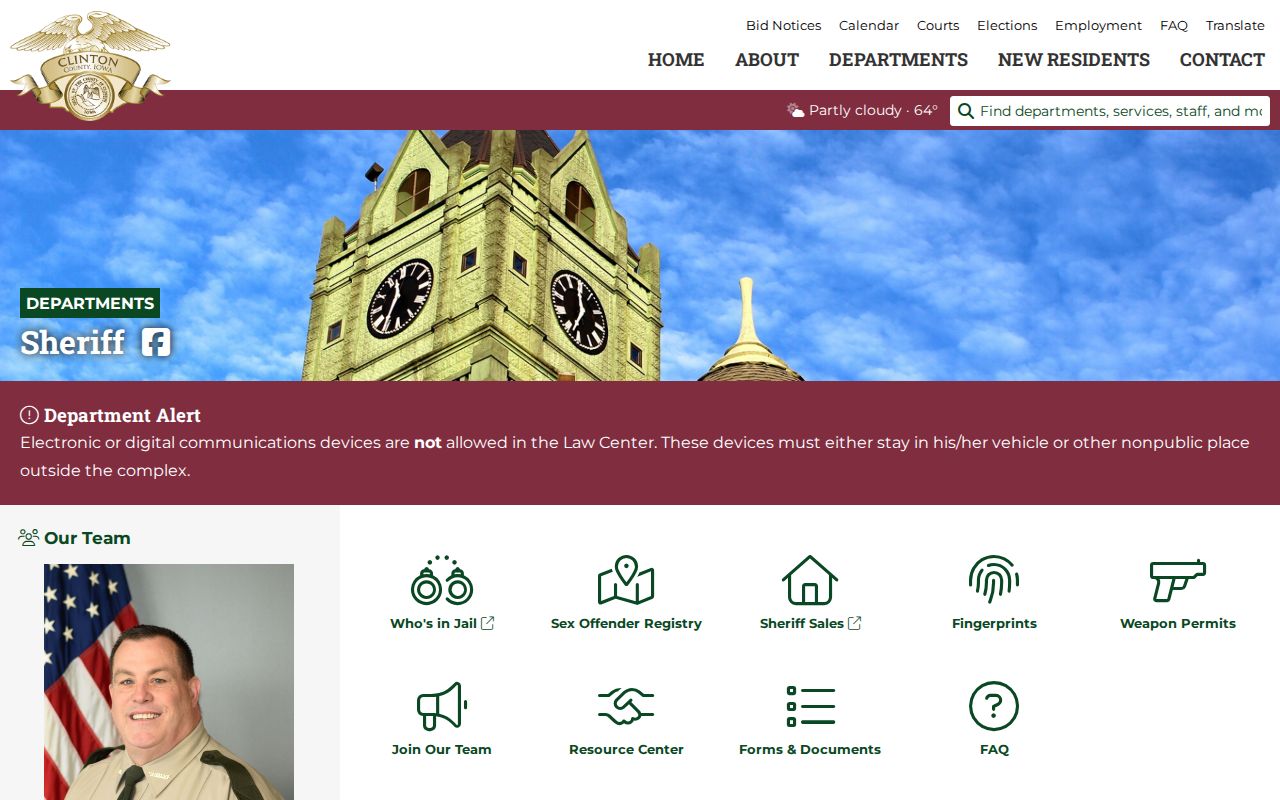
The Clinton roster is JavaScript-based and can fail to load. Call 563-242-9211 for current Clinton custody confirmation when it does. Clinton County does not publish a separate daily arrest blotter or a current jail-capacity figure, so neither should be inferred from the roster.
Clinton jail status is brief by nature. A person may be cited instead of booked, released before a search, transferred, or held on allegations later changed by the prosecutor. Iowa DOC Offender Search serves sentenced state custody and supervision, not a recent Clinton County jail stay. Clinton jail mail, calls, money, and weekday visitation use separate county rules and do not expand what a booking entry proves.
Note: Current custody, a police report, and a court disposition must be checked in their own official systems.
Public Access Laws in Iowa
Iowa’s public-record rule begins with access, then applies specific confidentiality laws. A Clinton County request must go to the Clinton agency that holds the document. Clinton County has no pooled file of every sheriff and city police report. Active Clinton investigative details, protected victim information, personal identifiers, juvenile material, and expunged records may be withheld or redacted.
Key Iowa statutes:
Iowa Code §§22.2 and 22.3 allow inspection and copying of public records, subject to lawful limits and reasonable actual costs.
Iowa Code §§22.7 and 22.8 cover confidential categories and the time allowed for a good-faith confidentiality review.
Iowa Code chapter 692 controls DCI dissemination, including restricted nonconviction information.
Iowa Code chapter 901C governs the covered expungement remedies and confidentiality.
Section 22.8 says a good-faith delay to decide confidentiality should ordinarily be no more than ten business days and cannot exceed twenty calendar days for that purpose. It is not a promise that every request will be completed within those periods.
Clinton County Court Search Fields
Iowa Courts Online can search Clinton County by name, exact birth data, case ID, or citation. Clinton name mode needs at least two letters in the last or firm name and accepts the percent sign as a wildcard. Date-of-birth mode calls for exact Clinton name and birth data. Case-ID mode requires Clinton County, a case type, and the full 17-character identifier.
Public Clinton trial cases after 1998 are covered, with some earlier matters. A new Clinton case may take one business day to appear, and a citation may take up to fourteen days. Juvenile and confidential cases do not appear. Older or unconverted Clinton records go through the clerk, and the courthouse terminal supplies access to electronic documents and some detail that is not free online.
- Trial information
- The County Attorney’s formal Iowa charging document.
- Disposition
- The recorded outcome of a charge or case.
- Deferred judgment
- A process that withholds judgment while conditions are completed.
- Bond
- Security and conditions tied to release.
Sealed, Expunged, and Restricted Records
Most Clinton juvenile court records are confidential under Iowa Code section 232.147. Iowa Code section 901C.2 generally addresses numbered Clinton criminal cases in which every charge ended in acquittal or dismissal, subject to exceptions. Section 901C.3 provides a one-time Clinton route for certain misdemeanor convictions after more than eight years if its conditions are met, including no pending charges and payment of court-ordered financial obligations.
Many offenses are excluded, so Clinton eligibility depends on the current law and the precise case. An application is filed in the existing Iowa District Court matter through the Clinton County Clerk. The research did not establish a distinct Clinton filing fee; confirm the current form, notice steps, and any charge with the clerk at 563-243-6213.
A discharged deferred judgment needs special care. The court record may be expunged after successful completion, yet DCI retains a nonconviction entry marked discharged and releases it only with signed authorization. A deferred sentence is different because it remains a conviction. After relief, recheck the court portal and request personal DCI review if the repository does not match the order.
Clinton County Records Geography
Official Clinton County history explains why today’s court and sheriff records sit in Clinton.
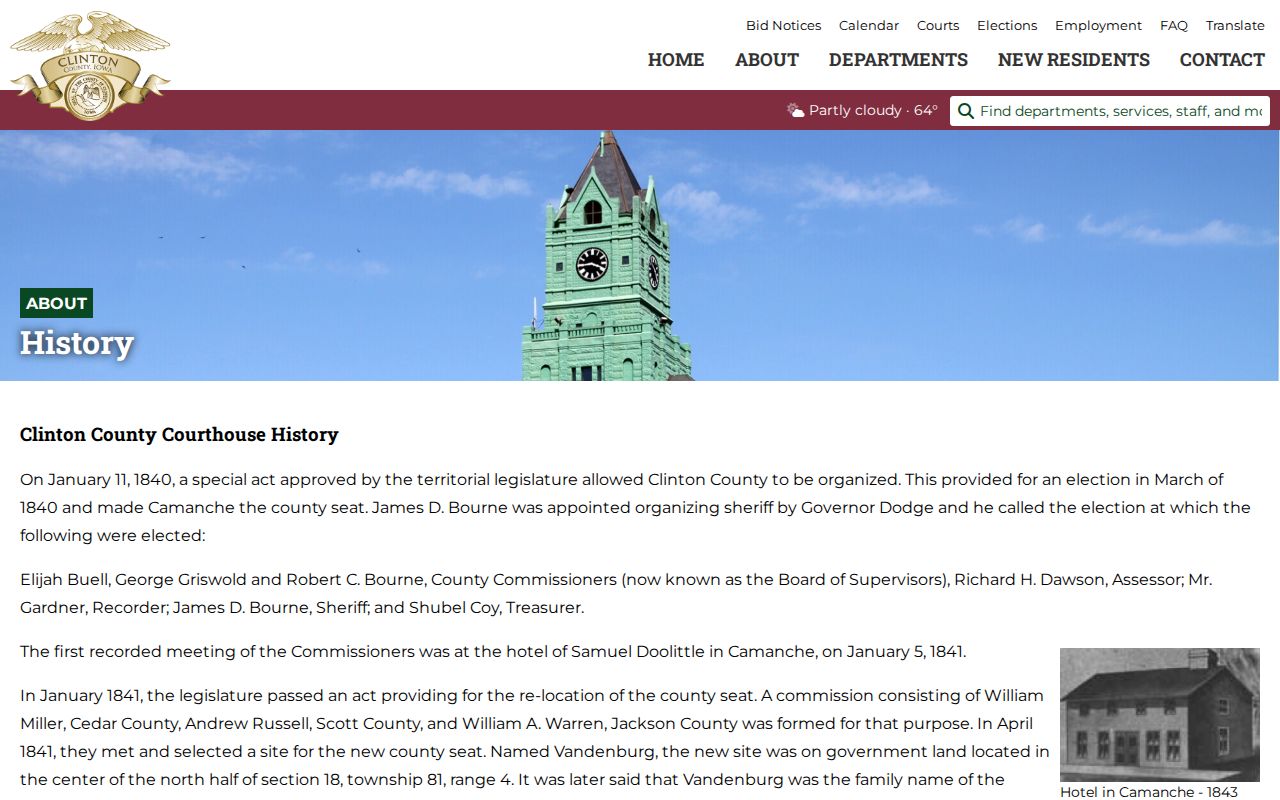
The county was organized under an 1840 territorial act. The first commissioners met at a Camanche hotel in 1841, and a county-seat vote moved government to Clinton in 1869. County history even recounts DeWitt residents burying the old courthouse bell in Elmwood Cemetery for more than a year during the dispute.
That Clinton County history has a practical result. Clinton is the place for the courthouse, Clinton Law Center, County Attorney, and a Seventh Judicial District field office, while city police reports stay with Clinton, DeWitt, or Camanche police. The Clinton sheriff also lists a DeWitt satellite at 226 11th Street, but its precise services and hours were not located. Call before assuming that the satellite can provide a Clinton report or fingerprint appointment.
Clinton County Corrections Records
The Iowa Department of Corrections search gateway leads to state offender information.
Use that route for permitted state custody and parole fields, not a person held at the county jail. Clinton County’s field office is at 121 Sixth Avenue South, Suite 101, and can be reached at 563-243-7943.
The Seventh Judicial District structure serves Clinton and four nearby counties. Its work includes probation, parole, pretrial supervision, residential placement, presentence investigation, and treatment programs. Public search data is narrower than an officer’s working notes or a full list of supervision conditions. For a sentencing or revocation filing, use Iowa Courts Online. For current county detention, use the sheriff’s roster. For a targeted DOC record, Iowa DOC provides its own chapter 22 request channel.
Clinton County Criminal Records by City
The three largest incorporated cities use their own police channels, but none has a municipal court. Clinton, DeWitt, and Camanche cases that reach court flow to Iowa District Court for Clinton County. Detention flows to the county jail. Each city page keeps the local police-report route distinct from the shared county court and custody systems.
Clinton Criminal Records
24,434 residents in the 2020 Census. Police Records uses a dedicated phone channel.
DeWitt Criminal Records
5,514 residents in the 2020 Census. Police counter hours differ on Fridays.
Camanche Criminal Records
4,570 residents in the 2020 Census. The city sitemap is the stable police gateway.
City population figures share the same 2020 Census vintage. They explain the ranking only and do not suggest anything about crime or safety.
Clinton County Record Boundaries
Operational figures need the same care as personal records. Clinton Police reported 43,084 calls or events, 47 OWI arrests, and 1,281 arrests or citations for 2022. Those labels combine different types of activity and should not be treated as a county crime rate. The report also discussed force events, training, crisis response, and license-plate camera use. Such data adds dated context, not proof about a person or a forecast of risk.
Record boundaries offer a better rule. A call is not always a founded crime. An arrest is not a conviction. A court charge can be amended or dismissed. A registry listing concerns a specific statutory duty, while a jail entry addresses present custody. Readers should preserve the source’s label and date, then verify the outcome with the office that created it.